A Reel is the hardest of Instagram's three video formats to transcribe. Not because the audio is special, but because of what sits on top of it. Here is what actually breaks, and what to do about it.
Updated 8 October 20264 min read
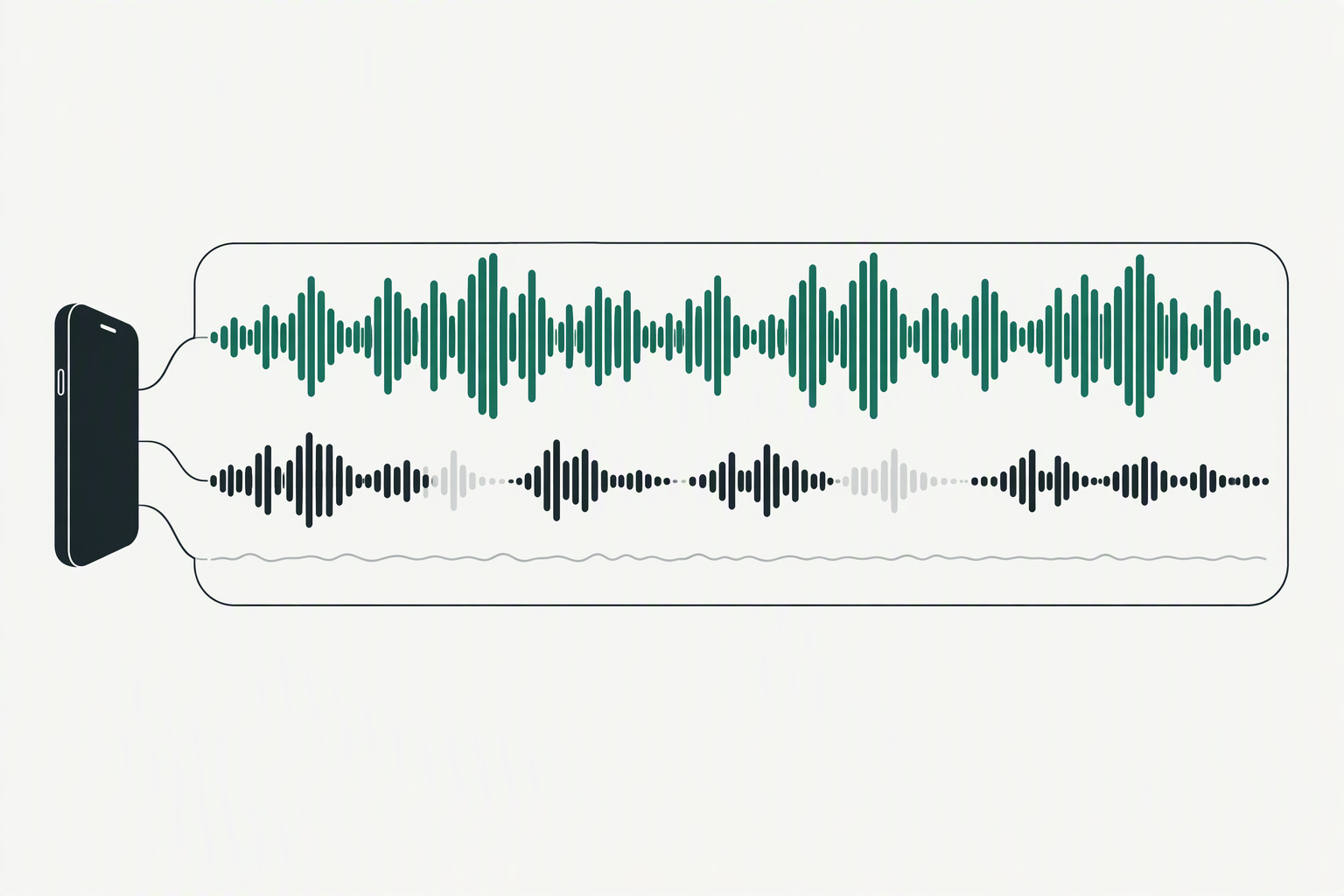
Three layers in one Reel: music on top, the voice underneath — and the stretches where the music wins.
The short answer
To transcribe a Reel, you turn its spoken audio into text. In practice this is the same job as transcribing any other video — with one difference that matters: a Reel usually has a music track underneath the voice, and that music is the single most common reason a Reel transcript comes back wrong. Everything else in this guide follows from that one fact.
Three things that break a Reel transcript
Music over the voice. A Reel's soundtrack is mixed deliberately — often loud, often with a beat that lands on top of the speech. A transcription step has to pull the voice out of that mix. When the music is louder than the speaker, words get lost, and the tool has no way to tell you which ones.
On-screen captions that disagree with the audio. Many creators burn subtitles into the Reel. Those on-screen words are frequently a cleaned-up version of what was said — trimmed, reordered, or rewritten for reading. If you are comparing a transcript against what you see on screen, expect differences. The audio is the source of truth for a transcript; the on-screen text is not.
Very short clips with almost no speech. A 12-second Reel that is mostly a visual with one sentence at the end gives a transcription step very little to work with. You get that one sentence and nothing else, which is correct but rarely what people expected.
Reels vs Stories vs video posts, on this one axis
If a transcript came back poor, the format is usually the reason, in this order of difficulty:
Reels — hardest. Music bed, burned-in captions, short duration. All three failure modes can appear in one clip.
Stories — mixed. Often a single voice with little music, which transcribes well. But Stories expire, so there is often nothing left to work with.
Video posts — easiest. One audio track, usually no music overlay, longer runtime. This is where results are most predictable.
So when someone says "Instagram transcripts are unreliable", they are usually describing Reels and generalising. The other two formats are considerably better behaved.
What actually helps
You cannot change the Reel. But three things improve the odds:
Pick the spoken language instead of leaving it on auto-detect. On a short clip with music, auto-detect has little to work with and can guess wrong. Naming the language removes one variable.
Prefer the Reel with the most talking. If a creator posted the same idea twice, one with music and one without, the one without will transcribe better. This is obvious once stated and forgotten in practice.
Read the transcript against the video, not against the on-screen captions. Comparing against burned-in captions guarantees you will "find errors" that are not errors.
What you will never get
Two limits worth stating plainly, because tool pages tend to skip them:
Private Reels. If a Reel needs a sign-in to open, its audio is not publicly reachable and no tool can transcribe it. This is what "private" means, not a shortcoming of any product.
Words that were never spoken. Text stickers, titles, and text-on-screen that nobody says aloud will not appear in an audio transcript.
Frequently asked questions
How do I get a transcript from an Instagram Reel?
Copy the Reel's link, paste it into a transcription tool, and read the text that comes back. It works when the Reel opens without signing in.
Why is my Reel transcript full of wrong words?
Almost always the music. A loud track over the voice is the most common cause of dropped or garbled words in a Reel transcript.
Should the transcript match the captions shown on the Reel?
No. On-screen captions are often edited for reading. The transcript follows what was actually said.
Are Reels harder to transcribe than normal videos?
Yes. Music beds, burned-in captions, and short runtimes all make Reels the hardest of Instagram's video formats.
Can I transcribe a private Reel?
No. If it requires a sign-in to open, its audio is not publicly reachable.
Does the transcript include the song lyrics?
No. A transcript captures speech. Music and lyrics are not transcribed as part of a speech-to-text result.
What if the Reel is mostly silent?
You get the words that were spoken and nothing else. If a Reel has one spoken sentence, the transcript will have one spoken sentence.
Do Stories transcribe better than Reels?
Usually yes — Stories more often have a single voice with little or no music. Their limitation is that they expire.
Try it
If you have a public Reel in mind, you can turn it into text on the main page — paste the link, name the spoken language, and read the result.